

 Help take extra special care of an elephant that is close to your heart.


 This week’s EleFact looks at the rate at which elephants get cancer and why it’s relatively rare when compared to humans. Science tells us that the more cells an individual has, the more chances there are for mutation. An African elephant has about as many cells as 100 adult humans put together. Common sense tells us that elephants should therefore be more prone to cancer than humans, but that’s not been found to be the case. It turns out that cancer could be more rare in elephants than this logic may suggest.
It’s important to remember that humans make decisions about lifestyle choices that may impact their likelihood of getting cancer; elephants don’t make those same risky decisions. But that still doesn’t account for the extreme difference in cancer rates. We can’t independently confirm the number of elephants with cancer or the rate that cancer develops in elephants, so we recognize there may be some wiggle room in the numbers listed here. But, generally, the bigger an animal gets, the more its cancer risk increases, and research has shown that elephants have about the same cancer risk as striped grass mice, which are about 100,000 times smaller. There are a couple of clues as to why.
Scientists have found a tiny protein called p53, which was the first time a protein that is used to prevent cancer was found in the body. It’s a tumor suppressor and stops damaged cells from copying themselves and instead allows them to repair themselves. If the cells can’t repair themselves, they die, preventing potentially cancerous cells from forming. Problems with p53 are linked to many adult cancers. Elephants have at least 20x the copies of the gene that makes p53 (called TP53) compared to humans.
Lab studies have shown that this gene also destroys damaged cells in human cancers. By studying the differences in the genes of each animal, researchers hope to learn more about how our human bodies fight cancer and how this process of creating cancer-fighting proteins could potentially be a model for future cancer medicines.
Elephants also have extra copies of another tumor suppressing gene: LIF (also found in elephant cousins hyraxes and manatees). This gene is referred to as the “zombie” gene, because many of the copies don’t initially seem to do anything. But when DNA in a cell is damaged, p53 can bring this zombie back to life, giving elephants more opportunity to encourage those cells to self destruct.
For the past decade, researchers have been trying to discover how these cancer fighting genes and proteins developed. Another team of scientists found even more genes and proteins in elephants that could help them fight cancer. Some of these genes and proteins are shared with other cancer-resistant animals like naked mole rats and horseshoe bats. If these genes and proteins play such an important role in protecting a group of diverse animals, there’s a good chance that they’re relevant to human health, too.
For more information, check out this article:
https://news.cancerresearchuk.org/2023/08/12/can-elephants-get-cancer/
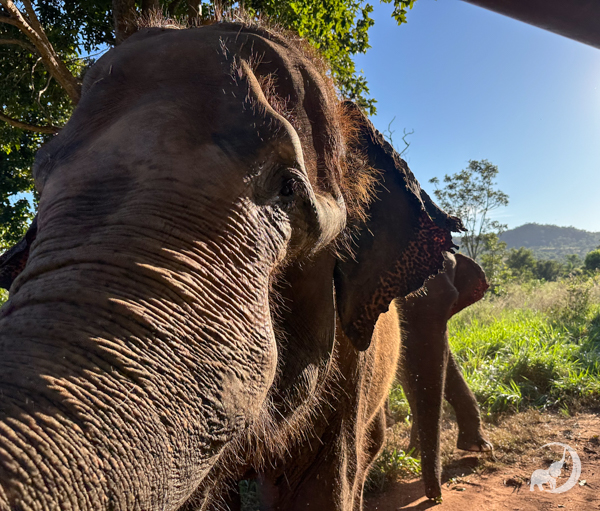
Photo of Rana and her wrinkly nose


Comments(2)-

-


Bonnir says
June 7, 2025 at 12:08 amSara thanks for the article about Cancer in Elephants I learned something new
Barbara L Smith says
June 8, 2025 at 3:59 pmThank you for another interesting fact about elephants. They are truly unique.🐘❤️
Subscribe to our Blog
Become an EleGuardian
Shop for Eles & Humans
Choose a treat or much-needed item for one of the elephants… or shop for apparel, accessories, and more.
Categories
Archives