

 Help take extra special care of an elephant that is close to your heart.


 As the seasons change all around the world, some of us humans may be experiencing stuffy noses and itchy eyes–a telltale sign of allergies. For today’s EleFact Friday, we want to look at the respiratory systems of elephants and specifically at allergies in animals, both wild and domestic.
It’s no surprise that, like many other anatomical systems of elephants, their lungs are quite impressive. Elephants are actually the only mammal on Earth without a pleural cavity, or the fluid-filled space between the lungs. Their lungs are directly attached to the chest wall and the diaphragm by connective tissue, which is unique. This results in their breathing depending entirely on movement of the chest muscles as opposed to the expanding ribcage, like in humans.
Research has shown that this aspect of their physiology allows for more direct muscle control, which contributes to their ability to better handle pressure differences when elephants take a dip underwater. This adaptation not only helps them immerse themselves and still breathe, but it also protects their lungs from spontaneous pneumothorax, where air accumulates between the lung and chest wall.
So your curiosity may have kicked in: with such an impressive respiratory system, unique to any other in the animal (or human) kingdom, do elephants get allergies? It has been shown in the past that animals of every species do demonstrate some health changes when exposed to certain allergens like spores, grass, and pollen. Research has determined that domesticated animals are far more prone to allergies than wild animals based on the “use-it-or-lose-it” aspect of evolution: centuries of living indoors with humans (assuming that the human homes have fewer allergens) may contribute to weaker immune systems. According to Andy Flies, a wild immunologist from the University of Tasmania, the evolution of wild animals may have removed allergies from populations as a whole. He used the example of a leopard stalking their prey and then sneezing when it gets close: natural selection would not allow for such sneezy behaviors in predator or prey populations in the wild.
Although captive elephants can show signs of food sensitivities and sometimes even itchy skin that may be considered to be allergy related, it seems that most elephants are lucky and manage to evade allergy symptoms as a whole.
P.S.: The Trunks & Treasures auction is winding up and will end tomorrow at 3 PM eastern time–but there’s still time for you to place your bids. Check out the beautiful artwork, home decor, jewelry, and experiences, including the once-in-a-lifetime trip to Elephant Sanctuary Brazil. Time is limited, so don’t delay! Click here to view the auction items and bid now.
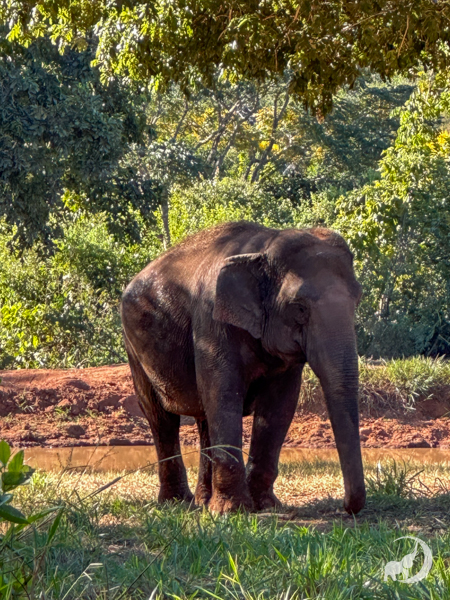
Photo of Maia in the shade


Post a comment