

 Help take extra special care of an elephant that is close to your heart.


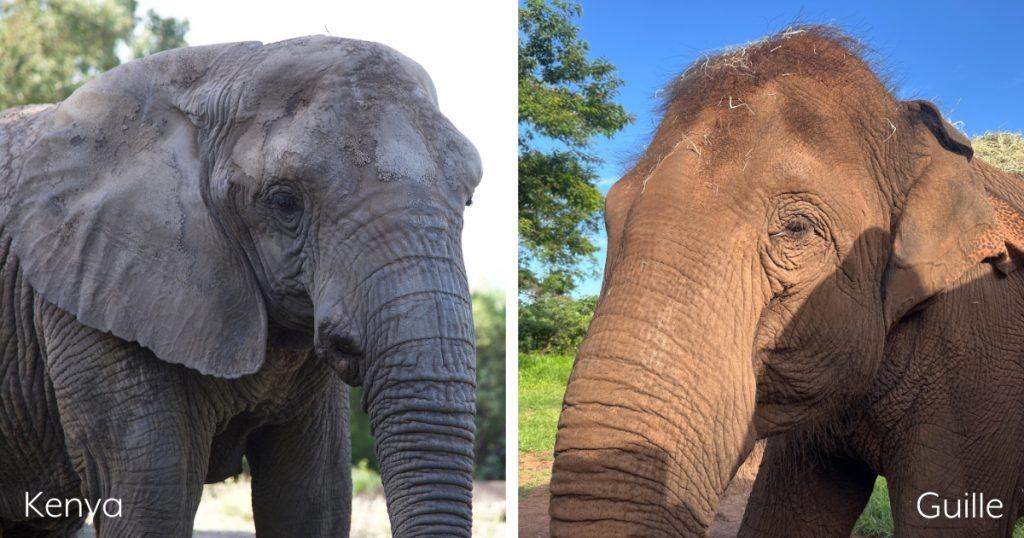
To date, all of our elephant residents have been female Asian elephants. But, as you all know, we are working toward welcoming our first female African elephants, Kenya from Mendoza in Argentina and Pupy from Buenos Aires. In addition to the uniqueness among the personalities of individuals, there are also significant differences between Asian and African elephants as species.
On a very basic level, there are physical differences between Asian and African elephants. Perhaps the two most obvious are their ears and tusks. Asian elephants have smaller and rounder ears than their African cousins, whose ears are larger and often compared to the shape of the African continent. All elephants use their ears to dissipate heat, but African elephants developed larger ears over time, due to the hotter climate of their natural environment. As for tusks, only male Asian elephants are able to develop tusks, but both male and female African elephants can have them. Female Asian elephants have what are called tushes.
Asian and African elephants also have specific head shapes. You have surely noticed that all of our current residents have what’s referred to as “twin-domed” heads, with a divot that runs down the middle; African elephants have rounded heads, without any divots. In general, African elephants are larger in physical size and weight than Asian elephants, which you will probably notice right away, once our new residents join us.
The species have a number of other unique qualities that we will explore as time goes on and we introduce our new residents. Each will have specialized diets, but they also have diverse qualities of their feet, tusks, number of toenails, ‘fingers’ on their trunk tip, teeth, lip shape, and skin texture. Still, they do share similarities, like their well-defined social structures in the wild. Both African and Asian elephants are matriarchal, with males eventually joining bachelor herds; they’re not always loners, as many used to believe.
There is no overlap in nature between the physical ranges of African and Asian elephants, so they do not live together in the wild. This is one of the reasons we have opted to build unique habitats for the specific types of elephants, to replicate their natural lives as closely as possible. There are also potential behavioral differences that would come into play, which has historically led to conflict. As with the arrival of any new elephant, the addition of African elephants to our current Asian group will bring exciting challenges and lots of unknowns. We are enthusiastic about the opportunity to expand our sanctuary family and to see how each individual grows into their new space.
The photo of Kenya and Guille highlights some of the differences between species.
Comments(5)-

-

-

-

-


- PO Box 2426
- Brentwood, TN 37024
- (615) 435-9523
-

-

-

-

-

-

- Ways to Support
- GSE Merchandise
- Privacy & Cookie Policy
Zoi Flores says
December 13, 2024 at 5:09 pmHappy dance for this long awaited news!!
Alejandra Enquin says
December 13, 2024 at 8:00 pmQue notables diferencias físicas y coincidencias en su organización social matriarcal ! Seguramente Mara que convivió con Kuki 💔y Pupy reconozca sus olores y sus sonidos cuando lleguén las africanas al Santuario.que emocionante!!
Sandy Crile says
December 14, 2024 at 2:27 pmWonderful news for Pupy and Kenya!! Are there any plans yet for moving Tamy? Once Kenya is gone, he will be all alone, even though he didn’t have access to Kenya, he knew she was there.
Kat Blais says
December 14, 2024 at 2:49 pmTamy still has no training except one several week long visit. Currently he won’t go to the only functioning training wall he has, they think it is possibly because he has to walk down into an area and it is painful for him. So they are building a ramp. It will be months before he will be anywhere near ready since he will have to undergo the same sanitary testing as anyone else. And he is due to go into musth, which means nothing can happen for the next few months.
Sue says
December 14, 2024 at 4:10 pmVery interesting post as always. Looking forward to getting to know the African lady Elephants more up close and personal once they arrive at Sanctuary. Thank you, as always, for keeping us informed and educated. ❤️🐘❤️
Subscribe to our Blog
Become an EleGuardian
Shop for Eles & Humans
Choose a treat or much-needed item for one of the elephants… or shop for apparel, accessories, and more.
Categories
Archives
Global Sanctuary for Elephants
Stay connected with our herd
MISSION: Protecting, rescuing, and providing sanctuary for elephants worldwide.
Global Sanctuary for Elephants is a 501 (c)(3) tax exempt, public charity status (EIN 46-3564818) and all contributions are tax deductible to the full extent of the law.
© Global Sanctuary for Elephants. All Rights Reserved