

 Help take extra special care of an elephant that is close to your heart.


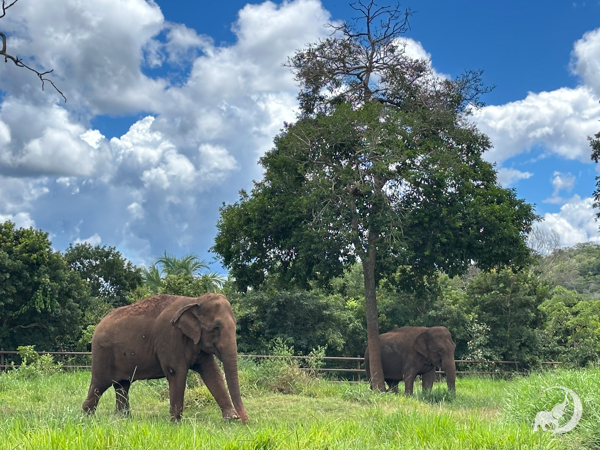 Over the past few years, scientists have noticed a fascinating and concerning trend in wild African elephants. This EleFact Friday, we’re looking at what researchers discovered regarding the tusks of African elephants in Mozambique, and what it means for the future of elephants in Africa. According to observations, genetic mutations may be causing some wild elephants who live in areas with heavy ivory poaching to be born without tusks.
The findings noted that a mutation responsible for tusklessness is becoming more common in areas where elephants are most frequently killed. Elephant slaughters became incredibly popular in the late 1970s and throughout the 80s, when global demand for the material reached an all-time high. This period saw the elephant population in Africa diminish by half. During the civil war in Mozambique, armed forces killed a large number of elephants, using the funds from ivory sales to fund the conflict. Only 10% of the elephants in the region survived.
Elephants without tusks are of no use to poachers, and, as a seeming result, a once-rare gene mutation has become more prevalent in female African elephants during periods of heavy poaching, since elephants without ivory tusks are more likely to pass on this trait. Tooth-building genes are likely involved in this occurrence and, if it’s present in male elephants of both species, it’s fatal. According to the study, about half of male African elephant calves with a tuskless mother will have this abnormality, which causes them to develop improperly in utero. Luckily, this problem is potentially reversible with time.
Both African and Asian elephants are endangered, but the current decreases are (as of yet) not as severe as they were 40-50 years ago. Given that, researchers believe the mutation will become less prevalent as conservation efforts improve. For more information, you can read the paper here: https://www.science.org/doi/10.1126/science.abe7389
Photo of Rana and Mara, who have tushes instead of tusks


Comments(2)-

-


Richie Chiger says
May 2, 2026 at 8:52 amRana and Mara are Asian females where the tush condition is normal, not mutated. The problem in Asia, where depending on the place of origin, about 70% of the bulls were tusked. This varied from 11% in Sri Lanka to 96% in south India and 99% in Maylasia. Now many more males are born and grow up as Muknas (tuskless bulls). The ratio of males to females, due to poaching is very skewed in Asia. Also, many young tuskers are captured and taken out of the gene pool. That is a really good reason for re-introduction of these bulls into the wild to re-spread those genes.
Africa is a different story. Only about 1% of African elephants were born with the tuskless gene and now, due to poaching for ivory, the number is up to 15%. This is human caused evolution and it is wrong and should not be. Hopefully, some day and some day soon, the ivory industry can truly die and maybe the normalcy of elephant evolution can turn around. According to this article the turn around can happen, There are people who feel that the tusklessness is good for the elephants as the poachers only have interest in killing for tusks. That would make sense, but it is still something that should not be. People have no right to bring about evolutionary change because of their greed. The illegal ivory industry must end. Also, all captive elephants should be re-introduced to the wild. Their torture in captivity must end.
Maria José says
May 4, 2026 at 8:01 amThank you for the info. I feel like reading more about this genetic “survival mechanism” – I am not sure if I could name it like that. Thank you for the photo of the two beauties.
Subscribe to our Blog
Become an EleGuardian
Shop for Eles & Humans
Choose a treat or much-needed item for one of the elephants… or shop for apparel, accessories, and more.
Categories
Archives