

 Help take extra special care of an elephant that is close to your heart.


Sensing With Whiskers
We’ve written before about elephant whiskers and how they differ from those of other mammals like cats or rats. These keratin-based fibers can sometimes sense frequencies and map out an animal’s surroundings as they come into contact with objects around them. Unlike those of the furry animals, elephant whiskers don’t move, twitch, or react to the environment in a noticeable way.
Elephant whiskers line the entire length of their trunks and a recent study used microcomputer imagery, electron microscopes, and other analysis to further study them. At the base of the trunk, the whiskers are thick, stiff (almost like plastic), porous, and covered in hollow channels that make them roughly 70% air; they progress toward being thin and soft at the tip where they are elastic like rubber. The shape transforms depending on where on the trunk the fibers are located. The research suggests that at the end of their noses, the whiskers are flat and almost blade-like, while those that are closer to the face grow rounder and perhaps serve to determine proximity to objects they can’t see too well up close.
To understand how this works, scientists, engineers, and neurobiologists looked at whiskers collected from captive Asian elephants who died naturally. They used electron microscopes, CT scans, and other tests to map the roots of the roughly 1,000 whiskers that line the trunk from top to bottom. Unlike other mammals whose whiskers sweep back and forth to examine their environment, elephants’ whiskers are stationary. A life-size 3D-printed replica of a whisker called a “whisker wand” was touched against hard surfaces and revealed that this stiff-to-soft transition tells us via senses where along the whisker an object makes contact. In effect, the researchers found that there was a difference in sensation depending on where on the trunk contact was made.
As more research is done, scientists and engineers can better understand how to create tools with the kind of versatility to pick up something delicate, like a corn chip, or something larger, like the melons Pupy once sucked up. To read more details, visit this link: https://www.science.org/doi/10.1126/science.adx8981
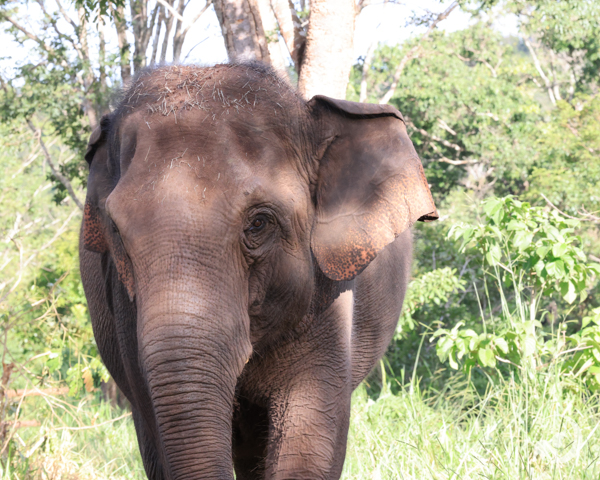
Photo of Guillermina, owner of many hairs and whiskers


Comments(3)-

-

-


Pamela Hall says
April 3, 2026 at 2:58 pmTheir magic grows
Ada says
April 3, 2026 at 6:24 pmThank you for continuously educating us about these beautiful, intelligent, amazing eles🥰
Finn says
May 24, 2026 at 2:20 pmGuillie❤💖❤💖
Subscribe to our Blog
Become an EleGuardian
Shop for Eles & Humans
Choose a treat or much-needed item for one of the elephants… or shop for apparel, accessories, and more.
Categories
Archives