

 Help take extra special care of an elephant that is close to your heart.


 Today’s EleFact delves into the misconception that, because elephants can be taught to perform certain behaviors, or because they have close contact with humans, they are actually domesticated animals. Though humans have been interacting with and using elephants for labor or entertainment purposes, that doesn’t take away their wild nature.
Domestication, like you would see with your dogs or cats, involves selecting specific characteristics and breeding to enhance those chosen features. This takes generations and involves genetic changes over time. Experts estimate that, to be domesticated, animals likely require at least 10-12 generations of selective breeding to reach a domesticated state. During that process, offspring from each generation are chosen for further breeding based on the desired traits. This can alter the animal’s basic instincts and anatomy. For instance, a dog or cat might be bred to have a specific kind of ear or tail, a calm or energetic personality.
Throughout the 3,000-year history of humans using elephants for various purposes, most elephants have been captured from the wild. A few, like Guillermina, may be first- or second-generation captive born, but they are not bred selectively for the traits humans might want. It’s not possible for one individual wild animal to become domesticated within their lifetime.
This is an important concept to understand, because the misconception allows people to view elephants as they would a pet, seeing them chained, ridden, or performing as normal. The reality is that, even in captivity, elephants are wild animals and should be respected and treated as such.
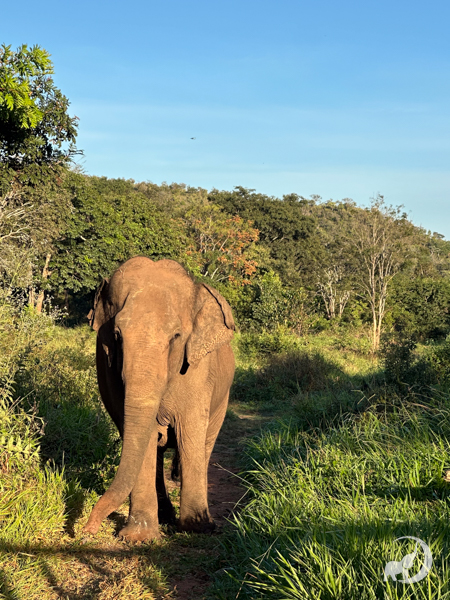
Photo of Rana walking through the green grass of the habitat
Comments(4)-

-

-

-


Sandy Crile says
June 27, 2025 at 2:34 pmMe thinks the girls at ESB have domesticated the staff rather than the other way around! They use their cuteness to get what they want…a nice shower from the hose, extra treats…
Nelson Courser says
June 27, 2025 at 4:39 pmGood post = thank you for the facts!
Terry says
June 28, 2025 at 11:46 amOnce again, excellent information about misconceptions and fact. Thank you.
Doe Fowler says
June 28, 2025 at 12:27 pmInformative post, thank you. Is the process more like habituation then?
Subscribe to our Blog
Become an EleGuardian
Shop for Eles & Humans
Choose a treat or much-needed item for one of the elephants… or shop for apparel, accessories, and more.
Categories
Archives
Global Sanctuary for Elephants
Stay connected with our herd
MISSION: Protecting, rescuing, and providing sanctuary for elephants worldwide.
Global Sanctuary for Elephants is a 501 (c)(3) tax exempt, public charity status (EIN 46-3564818) and all contributions are tax deductible to the full extent of the law.
© Global Sanctuary for Elephants. All Rights Reserved