

 Help take extra special care of an elephant that is close to your heart.


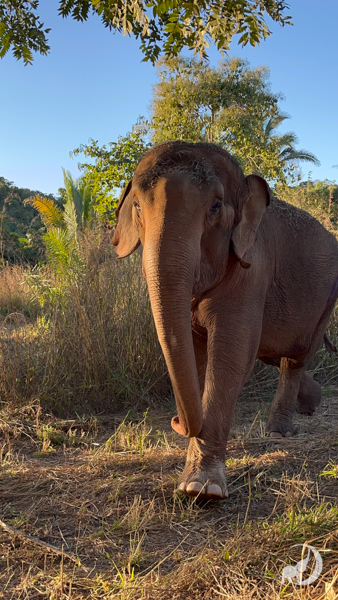 When we first met Baby at the amusement park, we noted that she exhibited some common captive elephant behavior: stereotyping, specifically repetitive swaying. She would slip into moving back and forth whenever she wasn’t having any direct contact with humans or some other notable stimulus. So, for this week’s EleFact, we’re going to focus on stereotyping, what it means, and how it can change over time.
Researcher Michael Fox described stereotypy as “unvarying, repetitive behaviors that have no obvious goal or function.” They’re thought to develop due to the inability of captive animals to control their environment or choose a desired behavior, according to Kathy Carlstead. In the wild, elephants would be foraging, wandering, and engaging in social interactions, but those things are often limited in captive environments.
Now that Baby’s at Elephant Sanctuary Brazil, we’ve witnessed a marked decrease in the amount of time she spends repetitively swaying. At this point, it is a decades-long habit and a way of coping, and that often doesn’t go away overnight. But, as we’d hoped, things started to slow down once she had access to the natural world around her; it gives her the chance to explore in any direction, build muscle, and it challenges her to drop emotional walls she may have built up, as she gradually becomes more comfortable. Slowly, her desires should become more elephant-like, and she can choose to expend her energies on something more stimulating.
It is normal for these behaviors to persist even after elephants are removed from their sterile or stressful captive environments, although stereotyping has been known to resolve fully or partially at sanctuary. It is a coping mechanism that she has used for years and will take time to work itself out. This also serves as another reminder of how brave she has become over the last month – which is so much to take in. We are continually amazed by the steps she has taken physically and emotionally in the face of so many different stimuli and experiences.
Photo of Baby striding more confidently
Comments(11)-

-

-

-

-

-

-

-

-

-

-


- PO Box 2426
- Brentwood, TN 37024
- (615) 435-9523
-

-

-

-

-

-

- Ways to Support
- GSE Merchandise
- Privacy & Cookie Policy
Title
USD
Sharon Klesse says
July 10, 2026 at 2:09 pmThank you for that explanation. It’s great that she is doing that less! Kudos to you guys! 👍🏻💕
Doe Fowler says
July 10, 2026 at 2:19 pmBaby’s skin looks beautiful! TY for the informative post. Peace and love to all! 🐘🌺🌴💖
Sue says
July 10, 2026 at 2:22 pmI love how we have witnessed Sanctuary help many of our wonderful Girls reduce stereotyping that they may have exhibited. I find it so distressing to see any elephants exhibiting this behavior as it makes me sad to think about what the underlying reasons are that they do it. I am thankful it is something they can often find relief from if given the opportunity for a better life, like at ESB. So thankful every day for all of our heroes at Sanctuary! ❤️🐘❤️
Audrey T. says
July 10, 2026 at 2:32 pmGreat post, nice to hear progress for the wonderful girl!
Johnny says
July 10, 2026 at 2:57 pmI remember first hearing that term applied to elephant behavior and it baffled me. It makes sense that an animal would find ways to cope with intolerable environments. Baby seemed to not exhibit that from the moment she walked onto sanctuary property.
Sara says
July 10, 2026 at 3:05 pmShe still sways from time to time, but she doesn’t do it for the length of time she used to and it’s not more periodic than constant.
Shelley Wolinsky says
July 10, 2026 at 4:03 pmIs it possible for a very healthy senior to come and volunteer to help at the Sanctuary?
Sara says
July 10, 2026 at 4:05 pmWe currently don’t have a volunteer program. We hope to have one eventually, but thanks for being interested!
Jeanine says
July 10, 2026 at 4:10 pmPoor elephants still in captivity.💔
I am sure grateful that Baby is overcoming her trauma.🙏
Rachel says
July 10, 2026 at 9:43 pmLove, love, love this for her. The swaying – once I learned what it represented – broke my heart every time I came across videos or documentaries on it. Knowing that Baby is already doing it less, and exploring the natural world more, makes my soul sing. Thank you for this most wonderful update. 🥹💕
Diane S. says
July 22, 2026 at 2:31 pmI’m so happy to know that Baby’s repetitive swaying has dramatically decreased. I’m sure this will continue to decrease as she becomes more and more acclimated and comfortable in her new sanctuary home 🐘💚
Subscribe to our Blog
Become an EleGuardian
Shop for Eles & Humans
Choose a treat or much-needed item for one of the elephants… or shop for apparel, accessories, and more.
Categories
Archives
Global Sanctuary for Elephants
Stay connected with our herd
MISSION: Protecting, rescuing, and providing sanctuary for elephants worldwide.
Global Sanctuary for Elephants is a 501 (c)(3) tax exempt, public charity status (EIN 46-3564818) and all contributions are tax deductible to the full extent of the law.
© Global Sanctuary for Elephants. All Rights Reserved
Your ticket for the: EleFact Friday: What is Stereotyping?
EleFact Friday: What is Stereotyping?