

 Help take extra special care of an elephant that is close to your heart.


 Over the past couple of months, we’ve been sharing thoughts from our care team about what it’s like to interact with each individual elephant: their unique qualities, personalities, and how they relate to their caregivers. We’ve heard from Michele on Maia, Luisa on Bambi, Flor on Rana, Sharon on Mara, and Barb on Guillermina. Our lead veterinarian, Dr. Mateus has his own distinct bond with all of the girls, and after years of working with wildlife and elephants, he deeply understands the special challenges that the girls and their humans both face. Here’s Dr. Mateus:
Being a veterinarian for captive elephants is quite challenging. The vast majority of captive elephants—if not practically all of them—come from backgrounds marked by neglect or even abuse. Because they are animals with such profound emotional, social, and cognitive intelligence, the mere fact that they are denied the opportunity to exercise these faculties is deeply stifling. Remaining for so long in sterile environments, without the chance to socialize, without a voice to express their feelings, and, ultimately, without the free will to desire or reject anything, corrodes and destroys their very essence.
Receiving a patient with this level of psychological impairment is a complex undertaking—extremely complex. First and foremost, one must provide space and demonstrate to the animal that they are finally safe to feel and to express themselves. This is not always immediately followed by a sense of calm or trust. Often, one must subsequently work to earn the animal’s confidence; after all, following decades of deprivation, trust does not tend to come easily or readily.
Following this, we face the necessity of initiating training. Most of the captive elephants we encounter here have had little to no experience with operant conditioning using positive reinforcement. We must introduce this concept and then begin the training process. It is worth noting that this is neither a linear nor a rapid process. Depending on the elephant’s history and individual temperament, trust may not be established quickly. And well… we know that, in most cases, those histories are horrific rather than benign.
This factor alone presents a significant agenda requiring immense work, development, and growth. Now, let us add the factor of poor physical health. The fact that these elephants have not undergone training—which would be the most straightforward method for facilitating daily care and medical monitoring—results in patients arriving at sanctuary with incomplete medical records, as well as a scarcity or total absence of prior medical examinations, treatments, diagnoses, and basic care protocols. Now, let us add the factor of the passage of time. We are speaking here of a near-total lack of care; many of these captive elephants have endured these conditions for decades. This often results in chronic diseases that are no longer curable, merely alleviated through palliative care aimed at providing greater comfort and well-being, while preventing acute exacerbations of existing comorbidities.
The sum of these factors constitutes the most common scenario we encounter in our practice: an apprehensive, elderly patient suffering from persistent ailments—an individual to whom we lack easy access until proper training protocols have been fully implemented. This frequently delays even the most basic treatments.
Furthermore, even when training is proceeding smoothly and trust has been established, we are confronted with diagnostic limitations, challenges that medical science itself has yet to overcome when dealing with an elephant. We can perform radiographs of the feet, obtaining clear images of the digits, or conduct an ultrasound to assess a nodule or mass located in the skin or subcutaneous tissue, but no deeper. However, no equipment currently exists that is powerful enough to radiograph an entire limb, thorax, or abdomen—let alone perform a comprehensive ultrasound of these regions. An endoscope allows us to examine the proximal portion of the trunk, but little beyond that. An intrarectal ultrasound could assess certain structures adjacent to the rectum; however, this provides only a minuscule snapshot compared to the vast expanse of an elephant’s entire abdomen. Even blood tests can be subject to bias; factors such as geographic location, or whether the animal is captive or has freedom to roam, can alter the established norms for a given species. The medications we utilize rarely have published dosages for elephants in the way they do for humans or other animals. Consequently, there is a dearth of data regarding what constitutes a “normal range” for many of these diagnostic parameters in a captive elephant in South America.
All these factors converge to create a situation of such complexity that, when it comes time to institute a treatment plan, we find ourselves with very few options in terms of complementary diagnostic tools. The more work we do and the more knowledge we gain about how to approach the animals as individuals, the better we can customize our treatments, and the more open we can be to new ideas that may emerge. Having such a dedicated care staff gives us the ability to be flexible with our options, hearing all individual opinions that can guide us forward, despite the undeniable challenges captive elephants–and all who care for them–face.
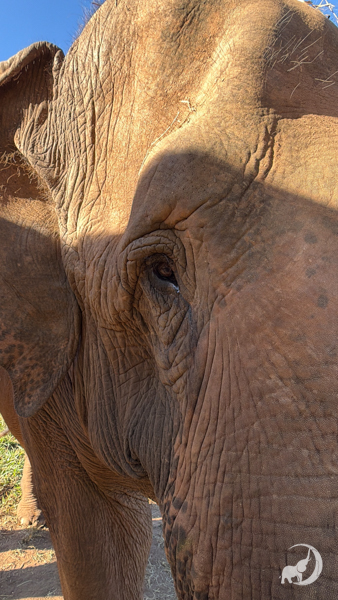
Photo of the gorgeous Rana’s face
Comments(10)-

-

-

-

-

-

-

-

-

-


- PO Box 2426
- Brentwood, TN 37024
- (615) 435-9523
-

-

-

-

-

-

- Ways to Support
- GSE Merchandise
- Privacy & Cookie Policy
Title
USD
Linda D Charles says
July 13, 2026 at 2:23 pmProfoundly sad that all of our captives aren’t as blessed as the girls have been. Thank you so much Dr. Mateus.
Richie Chiger says
July 13, 2026 at 3:12 pmVery sad, describing the living conditions of captive elephants and it is very interesting listening to the caring and concern. If there is a way for us, as those who love these magnificent beings, to end the horrors that they have to endure in captivity, then we must all get together and do it. I have been reading much lately about returning captive elephants to the wild in Africa and Asia. That, I believe, should be the goal sought for all captive elephants whose health and wellbeing could render them being candidates for such a life of freedom being returned or given to them. Of course, until that propitious time, people like this wonderful and concerned veterinarian are so necessary and important and technology that measures the needs of the elephants’ bodies must be secured.
Doe Fowler says
July 13, 2026 at 3:18 pmThank for this heartfelt post, Dr. Mateus. You and the care team are Heaven sent!
Nicole says
July 13, 2026 at 4:31 pmWow, I never realized the depth of what challenges you face when you bring an elephant to the sanctuary. Thank you for explaining and for your up-hill battle negotiating care for these beautiful creatures!
Ada says
July 13, 2026 at 4:41 pmI knew there would be challenges in giving medical care to these girls, BUT wow! I never knew how much or how great these challenges are. I am always amazed and impressed by the level of understanding, patience, kindness given to these beautiful eles. Thank you Dr Mateus for your in depth explanation and for being an awesome doctor for them💗🥰
Jeanine says
July 14, 2026 at 10:13 amHi there. I am sure you are aware that Portugal has opened an elephant sanctuary. I am so happy about this! I wish we had one in Canada. Maybe they would let Lucy go there.🐘
Bonnie says
July 15, 2026 at 12:40 amSara thanks for this article and Thank all of you at the Sanctuary for sharing and caring for these girls
Barbara L Smith says
July 18, 2026 at 6:57 pmThank you, Dr Mateus for this educational and interesting post. I have a question. Do you and the wildlife veterinarians in other sanctuaries worldwide, have a forum to communicate, exchange ideas and methods of treatment for the elephants.
Sara says
July 20, 2026 at 12:05 pmThere’s no official forum, but sanctuary people tend to know each other. People have reached out to us in the past and we’ve done the same when we were looking for educated opinions on things.
Diane S. says
July 22, 2026 at 2:24 pmThis was very detailed and so interesting, though simultaneously quite sad, in consideration of the many limitations and long term damaging effects captive elephants face in their lifetimes prior to arriving at the sanctuary 🐘💚
Subscribe to our Blog
Become an EleGuardian
Shop for Eles & Humans
Choose a treat or much-needed item for one of the elephants… or shop for apparel, accessories, and more.
Categories
Archives
Global Sanctuary for Elephants
Stay connected with our herd
MISSION: Protecting, rescuing, and providing sanctuary for elephants worldwide.
Global Sanctuary for Elephants is a 501 (c)(3) tax exempt, public charity status (EIN 46-3564818) and all contributions are tax deductible to the full extent of the law.
© Global Sanctuary for Elephants. All Rights Reserved
Your ticket for the: Caregiver Notes: Dr. Mateus on Elephant Medicine
Caregiver Notes: Dr. Mateus on Elephant Medicine