

 Help take extra special care of an elephant that is close to your heart.


 We all know that elephants can communicate with each other and gain environmental information from vibrations. Everything from a simple footstep to a low rumble generates seismic waves that travel through the ground to other elephants. But as time goes by and elephant interactions with people become more fraught, African elephants seem to be listening to man-made vibrations to give them information about humans.
Researchers at the University of Oxford published a study finding that African elephants are starting to move away from human-generated seismic waves, meaning that they are likely associating them with high risk scenarios. We’ve talked in the past about elephants learning the difference between groups of people who might be threats and those who are more likely to be less dangerous. We’ve also mentioned that wild elephants seem averse to bees. But until now, there’s been no solid evidence that vibrations of non-elephant origin can travel through the ground in the same way that elephant noises can.
Conservationists are concerned that this human-made noise could potentially interfere with the natural signals that elephants look to for survival. Scientists played wild African elephants seismic recordings of elephant sounds, human-generated white noise, and a combination of both. When the elephants detected the human noises, whether alone or in tandem with other natural sounds, the elephants would move away from those noises. This suggests that the animals likely associate human vibrations with danger.
Even in protected areas that should be quiet and remote, the ground can carry these vibrations from electronic equipment, vehicles, and other sources. Even when semi-masked by other elephant noises, the more human noises present and the louder and closer the sounds were, the more it impacted the elephants’ behavior. Their sensitivity to these ground-based vibrations shows that they use them for more than just inter-species communication, increasingly employing them for other purposes.
Chris Thouless, Head of Research at Save the Elephants, said: “We still know very little about how elephants use infrasound to communicate with each other and to appreciate their environment. They operate in a sensory world that is very different from our own, ‘hearing’ low-frequency noises through their feet. They may detect other elephants, distant thunderstorms, and noises of human activities at great distances. This skill helps them to survive in a complex environment, but man-made noises may overwhelm the more subtle signals from the natural world.”
As elephants continue to lose their native habitats to human encroachment, this research is likely to expand as we try to make sense of how we can all live in harmony.
For more information:
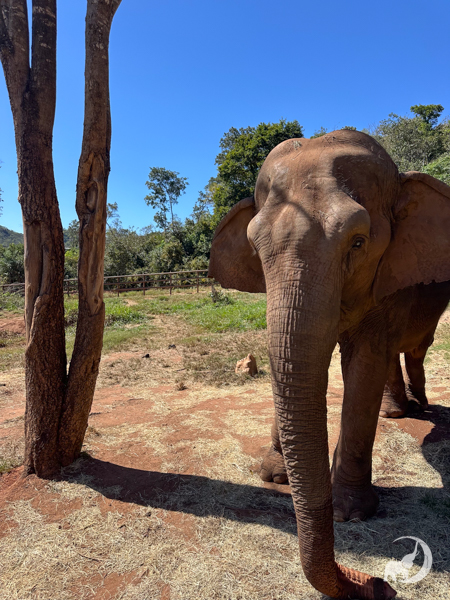
Photo of Bambi, who listens to the world around her carefully


Comments(2)-

-


Ada says
August 21, 2026 at 4:15 pmThis makes me so sad. Now with data centers popping everywhere that will surely affect not only humans, wildlife in general. So mad about this!
Carey says
August 22, 2026 at 12:03 pmI think cetaceans do this also, large tankers and ships, oil drilling, pleasure boats and the huger cruise liners send out a lot of noise which is thought to interfere with their sonar, so much human noise in the sea and they seek to escape it I think.
Subscribe to our Blog
Become an EleGuardian
Shop for Eles & Humans
Choose a treat or much-needed item for one of the elephants… or shop for apparel, accessories, and more.
Categories
Archives