

 Help take extra special care of an elephant that is close to your heart.


 There are a number of things that elephants have in common with humans. For instance, both are large-brained, social mammals with a long lifespan. However, physiologically, we have fewer things in common and are not closely related evolutionarily. This Friday, our EleFact will discuss how there are elements of the elephant brain and body that may actually correlate with functions of the human brain and body, and may actually help provide data on human aging.
It’s known that elephants can possibly live past their 8th decade, if given the chance to thrive. Because their lifespans are relatively long in the animal kingdom, it’s possible that they have evolved mechanisms to counter age-associated illnesses that impact humans, like cancer, cognitive issues, and comorbidities related to early life experiences. Because elephants rely heavily on memory and build multi-tiered relationships, they demonstrate – according to a recent study – a “dependence on social bonds, memory, and cognition to navigate their environment, behaviors that might be associated with specializations of brain anatomy.” So, we have enough in common sociologically that it might be beneficial to do a comparison between the two animals.
For example, studying elephant aging in comparison to humans may reveal important physiologic mechanisms that come with aging. Do elephants develop age-related diseases as frequently as humans, who live to comparable ages, yet have the benefit of medical technology? One way scientists are evaluating this is by looking at the gene TP53, which suppresses tumors. Humans have one copy, while elephants have between 19 and 21, depending on the species. While this initial discovery led some to claim elephants don’t get cancer, which we know to be false, it does seem that there is a lower incidence. This can be affected by lack of discovery (necropsy after passing) or lack of sharing accurate information. So it is hard to decipher the true numbers. But, it still may prove beneficial to do further research on captive elephants versus semi-captive or wild elephants. The differences in environment and social access may produce a range of opportunities for study when it comes to external factors impacting aging.
For extensive information on the possibilities of research, you can read a study here:
https://www.ncbi.nlm.nih.gov/pmc/articles/PMC9261397/
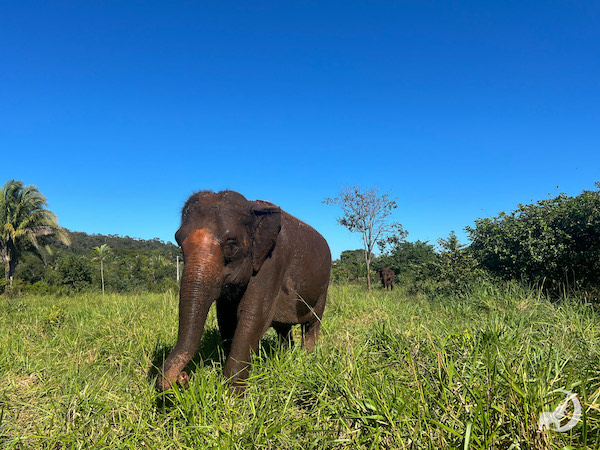
Photo of Maia with Bambi in the distance
Comments(4)-

-

-

-


Barb says
June 7, 2024 at 2:19 pmVery informative! It is fascinating to hear of the difference in numbers of the TP53 gene between elephants and humans.
Susan says
June 7, 2024 at 3:07 pmI simply love that elephants can have such a long life span if given the proper environment.
Carey says
June 9, 2024 at 5:59 amHow do they do medical testing on elephants? Thank you
Sara says
June 9, 2024 at 2:47 pmIt depends on what you’re doing/examining. The elephants here are trained using positive reinforcement in certain behaviors like leaning in for blood draws, etc.
Subscribe to our Blog
Become an EleGuardian
Shop for Eles & Humans
Choose a treat or much-needed item for one of the elephants… or shop for apparel, accessories, and more.
Categories
Archives
Global Sanctuary for Elephants
Stay connected with our herd
MISSION: Protecting, rescuing, and providing sanctuary for elephants worldwide.
Global Sanctuary for Elephants is a 501 (c)(3) tax exempt, public charity status (EIN 46-3564818) and all contributions are tax deductible to the full extent of the law.
© Global Sanctuary for Elephants. All Rights Reserved